
On my way home from business in Glasgow a couple of days ago I took a notion to stop off at the town of Renfrew near Paisley. This was partly nostalgic as my father used to drive a lemonade truck or ginger motor as they were once colloquially called and I would often help him during school holidays in the late 1970’s and early 80’s. The area around Paisley, including Renfrew, was his run and there were a couple of pubs and shops that he delivered to that I had not seen for many years.
The other reason that I wanted to visit the town was that I had read that there are two early steam engines on display by the riverside there (see featured image) that used to 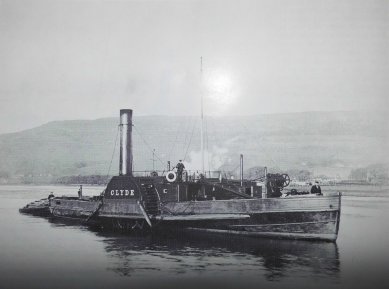 power the paddle tug Clyde (right) built by A&J Inglis of Glasgow in 1851. This long serving vessel was owned by the Clyde Navigation Trust and was used to assist in dredging work before she was eventually withdrawn from service in 1912. Sadly the boat was scrapped, but the engines were retained and put on display here by the riverside in memory of an Andrew Brown who was once Lord Provost of the town.
Not deterred by the wet wintry weather, and having satisfied my nostalgic inclinations, I soon found the landmark and, camera in hand, left the sanctuary of the car to have a closer inspection. First impressions were that they are well preserved and cared for, being protected by thick green paint and surrounded by tall railings. The original information plaque was present, but what was also nice was that there are three wide kerbs in front of the monument displaying carved images of ferries that have served the town since the 19th Century.

Now, the first of the images represents what looks like a cable ferry which, presumably, served the town in the 19th Century. The second image is of the last car ferry to operate on the crossing which is now used for a venue for events/concerts and can still be seen sitting on the North bank of the river close to the Kingston Bridge in Glasgow. The last kerb features an im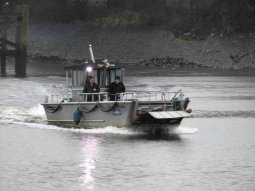 age representing the current passenger only ferry, the Island Trader (left), which is only a stone’s throw from where the engines now reside. Now, I can remember another passenger ferry which was operated by Strathclyde Passenger Transport Executive which took over the route when the car ferry was retired in the later 1980’s, I’m guessing, so these images are obviously not exhaustive of boats that have served the Renfrew-Yoker route.
 A nice happenstance was that as I was standing there watching the tiny Island Trader making occasional trips across the water whenever a passenger turned up, a fishing vessel by the name of Golden View (right) came puffing past, two of the crew offering me a friendly wave as I aimed the camera in their direction. It is not usual in this day and age to see fishing vessels this far upstream, so my guess was that she had been getting work of some type done to her somewhere upstream. Having since done a little research on the boat I can tell you that she was built in Peterhead in 1956 and that she is now in private ownership.
There are two other things worth mentioning that can be seen from the monument. Looking a few hundred yards upstream to your right hand side is the BEA Systems facility at Scotstoun, one of only 3 shipyards remaining on the river; the other two being BEA’s sister yard at Govan which also builds military boats – in fact, I could see two new looking warships from where I stood – and the other is the Ferguson yard in Port Glasgow which recent ly launched the Glen Sannox, a passenger and vehicle ferry soon to be working Caledonian MacBrayne’s Ardrossan-Brodick route (see my blog from 21/11/17).
Looking downstream to your left can be seen the giant Titan Crane which was once owned by the renowned John Brown’s shipyard in Clydebank, famous for building such iconic ships as the QE2, Queen Mary and HMS Hood. This crane is one of only four hammerheads left on the river, the others being at Finnieston, the Barclay-Curle one at Scotstoun and the other Titan which stands in Greenock. All these cranes, despite being listed structures, are in danger of being pulled down at some point in the future. As they are all visceral reminders of the great days of shipbuilding on the Clyde, it would be sad to see these majestic giants disappear from our landscape. Remember that listed status did nothing to save the Fairfield yard’s crane in Govan, pulled down in 2007.
Having assuaged my curiosity about this place, it was back to the car and off Paisley for some shopping. I’m not sure when I’ll be back, but I do fancy a trip over to Yoker on the microcosmic ferry to see what there is on the other side of the river, but perhaps on a sunnier day. So… what’s in Yoker, I wonder?
Picture of Clyde taken from The Clyde by John Riddell 1988.
Private tours to here as well as a range of other places can be booked by appointment.
 Dark Island Guided Tours