
Having conducted tours with people from diverse countries and cultures across the globe, I have found that there are two things people usually know about Scotland. one is the Loch Ness monster and the other would be that great Hollywood romaticisation of our history, Braveheart. I could write a whole blog about that film alone, but on this occasion I want to return to the Isle of Bute, where I began guiding back in 2013, to explore a few of the connections that the island has with that great Scottish patriot and freedom fighter, Mel Gibson.
Oops! Sorry, of course, I mean William Wallace, the son of a lesser noble from Renfrewshire played by the Australian actor in the 1995 blockbuster who, according to the legend, stubbornly refused to parley with the English occupiers and who inspired others, despite his lowly birth, to fight for his cause of freedom. Following on from the success of the film, Wallace has been ennobled to become a symbol of emancipation for oppressed nations and cultures across the world, not to mention raising Scotland’s profile and attracting lots and lots of tourists. Nice one Mel!
Wallaces loyal Butemen
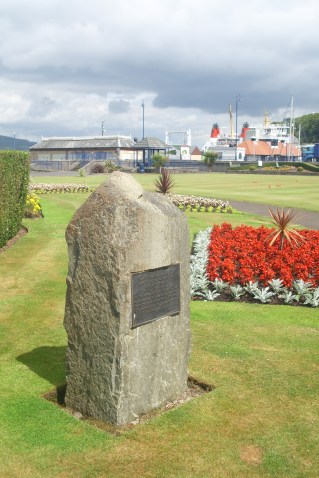 I should say that today’s post has been inspired by one of my readers who suggested that I write something about the Men of Bute who under the command Lord John Stewart fought alongside Wallace at the Battle of Falkirk in 1298 and who – according to John of Fordun in his Chronica Gentis Scottorum of the 1370s – to a man were killed. Now, we should bear in mind that Fordun wrote his account around seventy five years after the battle itself allowing plenty of time for the story to become embellished, exaggerated and generally dramatised; nonetheless, we can be reasonably confident that a good number of men from the island lost their lives on that fateful day. So much so that in 2013 a contingent from The Society of William Wallace traveled to Bute’s only town of Rothesay and accompanied by a good number of local dignitaries and members of the public paraded their way to the Discovery Centre; a fine Art Noveau style structure which doubles as the island’s tourist information point and cinema. There, with much pomp and ceremony, they unveiled of a small monument commemorating the bravery and sacrifice of Lord Stewart and his men.
Wallace’s great victory had been at the Battle of Stirling Bridge the previous year where he routed the English and demonstrated to his countrymen that Edward I’s English army were not invincible; however, his defeat at Falkirk heralded a period of several years in which Wallace, stripped of his title of Gaurdian, returned to his fugitive lifestyle before eventually being betrayed by the Scottish noble Sir John Menteith. He was then handed over to the English who, as you will know if you’ve seen the film, had him hung, drawn a quartered. As an interesting aside, the only body of fresh still water in Scotland that is not called a loch, Gaelic for lake, is the Lake of Menteith in Stirlingshire which on account of it’s erstwhile lord’s treachery does not deserve that title, or so the story goes.
The Stewarts
Fordun’s writing is also of note as being the first known mention of Brandane, a term used to this day to describe someone who is born on Bute. It is thought that this is a reference to St. Brendan, a saint from Brittany who was venerated by the Stewarts, an Norman aristocratic family who went on to become monarchs of Scotland and eventually England too – James VI of Scotland became James I of England and Ireland in the Union of the Crowns in 1603 – and who continue to have an association with the island up until the present day; John Crichton-Stuart, AKA Johnny Bute, being the 7th and current Marquess. His family seat of Mount Stuart welcomes visitors throughout the year to its extensive grounds where you can enjoy woodland walks as well as marveling at the wonderful late 19th Century Gothic mansion built by the 3rd Marquess.
By-the-way, if you are wondering about the alteration of the spelling from Stewart to Stuart, we have Mary of Guise, mother of Mary Queen of Scots, to thank (or should I say blame) for that. She was the French wife of James V. After his death at the Battle of Flodden in 1513, his daughter Mary was made Queen; however, as she was a mere baby at the time, the country was run by a regent. The old king’s widow eventually attained that position and it was her who changed the spelling as she considered it to be more French.
There is one other connection between Wallace and Bute that I know of, and that is the bishop of Dunkeld who was a supporter of Wallace and as a result became a fugitive himself after Edward’s victory. It is said that James Stewart, the Sherriff of Rothesay and son of John, gave the bishop refuge on the island; a stay that lasted three years. I’ve done a little digging regarding this; however, I must admit that I’ve struggled to come up with anything significant. If you know anything about this or indeed any other connections concerning Wallace and Bute then please let me know in the comments.
What to Visit

There are three important places to visit on the island associated with the period. One being Rothesay Castle, built by the Stewarts just after the turn of the 13th Century, it is remarkable for being one of the oldest castles in Britain and also for its unusual and almost unique shape, being round. I don’t know of anything which directly links Wallace to the castle, but it was certainly involved in the wider conflict of the times. In 1301 the castle was captured by the English before being recaptured by the Scots in 1306, this time under the leadership of Robert the Bruce, the other great leader and romantic figure associated with the struggle for independence.
By 1333 the English again had the upper hand. After defeating the Scots at Halidon Hill, Edward III installed Edward Balliol to the Scottish throne as his own puppet king and, if we believe Walter Bower writing circa 1440, unarmed islanders attacked Balliol’s men with rocks, killing the sherrif and retaking the castle once again. Brandanes are not to be messed with! In fact, the castle has been involved in just about every conflict in Scotland’s history up until 1685 when Archibald Campbell, the 9th Earl of Argyll, razed it to the ground in response to the Stewart James VII and II’s perceived attempts to restore Catholicism. In the 19th Century it was restored by the 2nd and 3rd Marquesses and today the castle is owned and managed by Historic Environment Scotland.
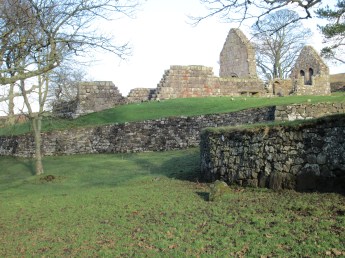 Another must-see is St Blane’s Church near to the village of Kingarth on the southern end of the island. Built on a the site of an earlier Celtic abbey in around 1135, the ruins of the church provide an idyllic sanctuary for those who want to escape the hustle and bustle of modern life. The progenitor of the Stewarts was a Walter Fitzalan who entered the service of David I in about the year 1136 as the king’s steward or stewart, hence the name. Although not a Norman himself, King David is said to have looked to the new Norman Feudal order that had been imposed in England with admiration and was keen to replicate the culture and governance of his southern neighbours in his own kingdom. With this in mind he invited Walter, a Shropshire land holder, to come north and take up what was the most senior of positions in his court giving him lands in Renfrewshire where he founded a Clunaic monastery at Paisley in around 1163. It was his son Alan who gifted St Blanes and the grange of Kingarth to the Church in Paisley heralding the the introduction of not only the Clunaic order to the island, but also the introduction of the Feudal system not to mention the island’s longstanding association with the Stuart family. Again, there is so much that I could say about St Blanes, but one thing I would recommend that you look out for is a remarkably well preserved grave stone which lies maybe fifty yards ahead of the church ruins which bears a cross and dates from the 9th Century!
 Rothesay High Kirk or high church on the outskirts of the town was built in the later 19th Century; although, it is sited on the location of the original St Mary’s Church. The only surviving remnant of that building is St Mary’s Chapel which dates back to the earlier 14th Century placing us just about bang in the middle of the period we are concerned with. For centuries the chapel was ruinous, but now is protected from the elements by a roof which is a good thing considering what is inside. Produced by the so-called Loch Awe School, a body artisan stone sculptors who are thought to have been based in the Loch Awe area of Argyll in the 14th and 15th Centuries, there are a number of effigies and grave slabs. Recessed into the southern wall is the Knight’s Tomb which is a sculpture of an armour clad man lying on his back with some kind of pillow beneath is head; however, we cannot say who he was other than to say he was a Stewart of royal lineage. Both he along with a graveslab figure on the chapel’s floor are wearing chain mail and helms thwarting the Braveheart notion of tartan, wild hair and painted faces; however, why let the truth get in the way of a good story!
In the opposite wall is another tomb which features a lady lying on her back with a baby whose identities are equally mysterious. To see more of the school’s work, I’d recommend that you take the short ferry journey across the Kyles or narrows of Bute at the northern tip of the island. Once off the boat turn left and travel for about three miles until you come to the village of Glendaruel and Kilmodan Church. There you fill find the Kilmodan Stones; the most outstanding and best preserved examples of the school’s work. Check out Historic Environment Scotland’s website for information of both sites.
https://www.historicenvironment.scot/visit-a-place/places/kilmodan-sculptured-stones/
Other Things to See and Do
 I have focused this blog on things relating to the 13th and 14th Centuries, however, Bute has many outstanding features to enjoy as part of your itinerary. The Bute Museum is well worth a visit and has many artefacts and displays ranging from Mesolithic flint used by Stone Age islanders to memorabilia relating to Rothesay’s importance as a holiday or vacation destination. They also have an entire section dedicated to natural history where you can learn more about the wildlife and geology of the island. There is also the magnificent Bauhaus Pavillion which is currently under renovation (due to open later this year although doubtful due too Covid-19); however, there are stone circles, Iron and Bronze Age hill forts, a 17th Century mansion house as well as the final resting place of a prime minister (at the High Kirk) to ease any disappointment.
If you grow tired of visiting this abundance of historical sites, why not spend some time in Rothesay eating in one of the several well furnished cafes and restaurants or browsing around some of the town’s numerous shops. The Golfers Bar is an excellent place to go to enjoy a pint whilst appreciating its beautiful Edwardian interior and there is even a gin distillery, Spirit of Bute, where you can sample well crafted local produce whilst browsing some of their high quality branded items.
How to get to There
The Isle of Bute is located on the firth or estuary of the River Clyde on Scotland’s West Coast. It is within easy reach of Glasgow involving a train journey from Glasgow Central to Wemyss Bay, a journey that takes just under an hour. From Wemyss Bay, after you have admire the fine Edwardian train station, hop on the Caledonian MacBrayne ferry and you will arrive in Rothesay within half an hour. Alternatively, if you are arriving via Glasgow Airport, catch a bus to Paisley Gilmour Street Railway station and take the Wemyss Bay train from there.
Accommodation and Tourist Services
At Dark Island, as well as providing guiding services, we can help with organising your itinerary, transport, eating out as well as entertainment. Just ask!
In addition, there is also the Discovery Centre whose friendly staff are always on hand to advise you of what to see and do.
If you have enjoyed this blog, be sure to subscribe. You can also find us on facebook and twitter where you can keep abreast of our latest adventures. Our facebook page has also started featuring regular live stream tours of various destinations and attractions.
Is there anywhere else in Scotland that you would like us to write about? If so, let us know in the comments..
 Dark Island Guided Tours