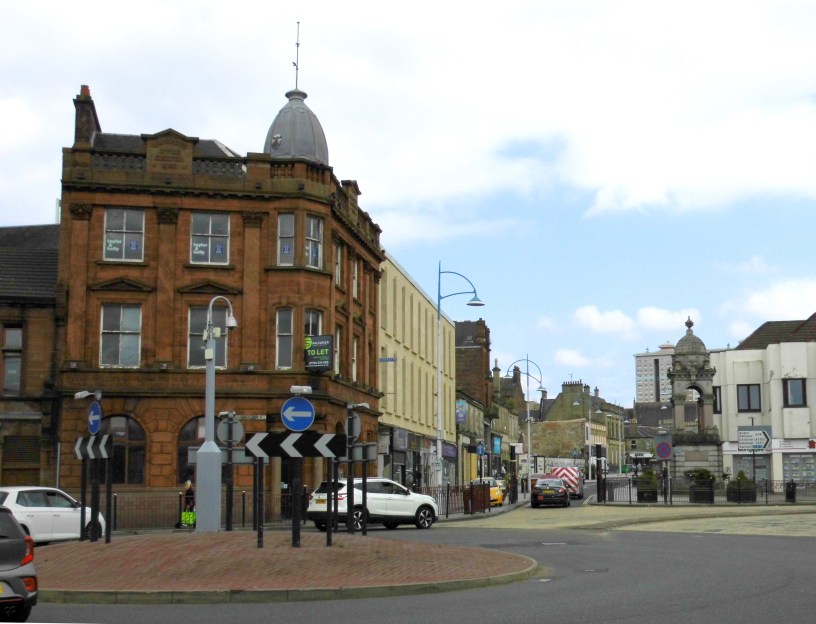
This week’s livestream has been inspired by one of my followers who now lives in Liverpool, but has family connections in the Lanarkshire town. Coatbridge is not a place that I can say I was particularly knowledgeable of before now, but having looked into it’s past, I can say that the town has a fascinating history, especially if you have an interest in the Industrial Revolution or Irish culture. Nevertheless, what ever you interest is in Scotland, you are more than welcome to participate and I am sure you will find something that sparks your interest, so please join me.
The livestream will start at 8pm BST – 3pm EDT, 2pm CDT, 1pm MDT, midday PDT – and can be viewed on the Dark Island Scotland Guided Tours facebook page.
The Iron Burgh
The Industrial Revolution was a time of great technological advancement and economic prosperity for some, but it was also a time of great social upheaval as dispossessed rural populations were being pressured to leave their subsistence lifestyles behind to become human fuel for the industrialization project. Gaels from the Highlands were being affected by the Clearances as greedy clan chiefs engaged in rent hiking and evictions to make way for large sheep farms. In the Lowlands and Ireland similar processes were underway as landlords sought to clear their lands of unprofitable tenants and in doing so compelled farm workers to migrate to the towns and cities of Scotland’s central belt in search of work.
The Irish Potato Famine of the 1840s only compounded the situation causing a great number of Irish families to embark on the short trip across the Irish Sea to seek new and happier lives in the industrial heartlands of Britain. Coatbridge on the outskirts of Glasgow was one such place that these refugees headed for as the as the town’s burgeoning iron and coal industries required more and more labor to keep up with the demands of empire. Even today it is estimated that around 60% of Coatbridge’s population come from an Irish Catholic background, so much so that the town is often known as Little Ireland. Iron was needed for ships, railroads, bridges and all manner heavy machinery and Coatbridge’s location on the mineral rich deposits of the Scotland’s central belt with easy access to the sea via the Monklands Canal put the town firmly on the map as one of Britain’s great industrial centers.
Coatbridge and its neighboring town of Airdrie are collectively known as Monklands after Cistercian monks who mined for coal in the area from the Middle Ages up until the Reformation of 1560 after which church lands were handed over to private owners. With the coming of the Iron industry in the later 18th, the production of coal intensified to the extent that by the 1920s the coal seams had been exhausted; furthermore, the mineral wealth of the area had been such that in the first half of the 19th Century the population of the town grew by 600%.
Another factor in the growth of the town was the advent of the hot blast. This technological advance was invented by James Beaumont Neilson who introduced it to the Wilsontown Iron Works in nearby Forth in 1828. It involved the re-circulation of air taken from the flume of the furnace back into it’s oxygen feed. The effect of this preheating of air was to decrease fuel consumption while at the same time increasing capacity and temperature. The iron industry in Coatbridge was quick to exploit this new technology with the Sumerlee Iron Works being among some of the first swelters to employ it.
Another famous Coatbridge Swelter was Gartsherrie which was associated with the Baird family. Alexander Baird, a local farmer, initially became involved in coal mining; however, with the introduction of the hot blast he became involved with iron too and he along with his six sons went on to establish many of the town’s foundries. One of his sons James, for instance, was responsible for the establishment of sixteen blast furnaces alone. Their influence on the development of the town was profound to the extent of designing the town’s layout and donating land for the building of a town hall. It is a testament to the family that they also donated land for the erection of a Catholic church despite being from a Scottish Presbyterian background themselves and this in an age of bitter sectarianism.
By the turn of the 20th Century the iron industry had gone into decline as the seems became depleted meaning that coal now had to be imported making it less viable to produce. Steel was also taking over and the neighboring town of Motherwell was emerging as the main center of that new industry. Another blow to the town was the relocation of the Union furnace in 1934 to Corby in Northhamtonshire taking great numbers of their workers with them. So much so that ironically that English town is now known as Little Scotland. By the end of the Great Depression the only blast furnace in the town was that of Gartsherrie which eventually closed its doors in 1967 bringing an end to Coatbridge’s association with Iron.
Popular Culture
In celebration of its Irish connections, Coatbridge has an annual St Patrick’s day celebration. Sponsored by the Irish government, the festival runs for a fortnight during which there are opportunities to partake in dancing, Gaelic football, Irish language classes, lectures or even attend film showings and music events. This is the largest Irish cultural event in Scotland and in 2007 was attended by the Irish President Mary McAleese.
The town even has its own professional soccer team, Albion Rovers, who compete in Division 2 (4th tier) of the Scottish Professional Football League. The legendary Celtic and Scotland coach Jock Stein at one time played for the Wee Rovers and Coatbridge man John ‘Yogi’ Hughes – named after American cartoon character Yogi Bear – was one of the famous Lisbon Lions, Celtic squad who in 1967 became the first British club to lift the European Cup. Another sporting legend from the town is Ricky Burns who is one of only a handful of boxers to hold world championships at three different weight divisions.
The Lees confectionery factory located in the town produces the Snowball, a short of round cake which is made of synthetic cream covered in Chocolate with flakes of toasted coconut sprinkled over it. Along with the Tunnock’s Tea Cake, also made in Lanarkshire, it has become one of the more traditional sweets in the Scottish culinary tradition.
What to Do
The Summerlee Museum of Scottish Industrial Life is a museum and heritage center built on the site of the old Sumerlee Iron Works. It is open all year round and features guided tours, miners’ cottages, all manner of industrial machinery, a children’s play park and it even has its own tram car system.
If you are looking for something for the kids to do you can’t go wrong at the Time Capsule, a sort of prehistoric themed water park that features wave machines, geysers, canals and waterfalls set in a backdrop of dinosaurs and prehistoric plants. Again, it is opened all year round and has its own gym.
Note that both Sumerlee and the Time Capsule are both currently closed due to Covid-19.
Drumpellier Country Park is the former Estate of Glasgow Tobacco Lord and Lord Provost (Scottish equivalent of mayor) Andrew Buchanan who was an owner of tobacco plantations in Virginia. Within its 500 acres you will find a range of habitats including two lochs (lakes), heathland, mixed woodland as well as open grass land. The park is home to a whole range of flora and fauna, particularly water fowl, and is an ideal day out for all the family.
How to Get There
The easiest way to get there by public transport is by train from Glasgow Queen Street to Coatbridge Central a journey of around half an hour. If you are travelling by car or bus, the town lies in easy reach of both the M8 and M73 motorways making it easily accessible from both Glasgow and Edinburgh.
Support Me on Patreon
If you would like to support me in producing more livestreams, blogs and content that you want to see then please consider becoming one of my Patreon patrons for as little as $1, £1 or 1 euro per month. In doing so you will get access to exclusive midweek mini tours and photos as well as having preferential treatment from myself in terms of information and suggestions regarding future streams.
Here’s the link: https://www.patreon.com/AlecMack
Cheers. Alec.
 Dark Island Guided Tours