Livestream will take place on facebook on Saturday 27th of June at 3pm EDT, 2pm CDT, 1pm MDT and midday PDT (8pm UK). Just visit the Dark Island Tours Scotland facebook page at the appropriate time.
The Crossroads of Ayrshire
The town of Kilwinning is modest in size having a population of just over 20,000, but it once was a place of far greater importance. Today it may appear as a quiet backwater where no one seems in a hurry and people have time time to stop for a chat, but this belies its history as a center of Christian learning that had authority over a great part of the surrounding landscape. Indeed, it is the neighboring town of Irvine that has risen to become the largest town and administrative center of North Ayrshire, but on closer examination it can still be argued that Kilwinning still deserves the title, at least in a spiritual sense, of being the Crossroads of Ayrshire.
St Winning and the Early Celtic Church
The town was founded in the early 7th Century by St Winning and like many towns in the area, it’s name begins with the prefix Kil-, which comes from the Gaelic Cill meaning cell. In other words Kilwinning is the cell of St Winning. Kilmarnock, Kilbirnie and West Kilbride are other nearby examples of this. Gaelic is seldom spoken in the area these days, but if one examines the place names of Ayrshire, it can’t be denied that it was once very common. As an interesting aside, Whitehirst Primary School will take in its first cohort of Gaelic Medium Education pupils this very fall, so perhaps in future years the Celtic tongue may be heard once again in the streets of the town.
There is some debate over Winning’s cultural identity. Some claim that he was an Irish saint, the teacher of St Columba who founded the monastery of Iona. As such he would have spoken Gaelic as his first language; Scottish and Irish Gaelic being very closely related languages. Indeed, it was the Scots who expanded their Kingdom of Dalriada in the north of Ireland to encompass part of Britain’s north western seaboard introducing the language and, in the process, founding the nation that would one day become Scotland.
It has also been suggested that he may have been Welsh; however, this has caused some confusion as it appears to conflict with other accounts that he was born in Scotland. What is often misunderstood is that another Celtic language, an early form of Welsh usually referred to as Brythonic, was spoken from before the time of the Romans up until the earlier Medieval period, so these two statements are not necessarily incompatible. In fact the surname Wallace – as in William Wallace, Scotland’s great hero of the Wars of Independence played by Mel Gibson in the 1995 blockbuster – mean the same thing coming from an old Anglo Saxon word Wealh meaning foreigner. This is rather ironic considering that it was the Anglo Saxons and the Gaels who were the recent arrivals whereas the Welsh had been here all the time.
Nervertheless, Gaelic held great prestige as it was the language of the clergy and by extension of education. These Irish priests and monks were literate, both in their own language and in Latin and so were encouraged by local tribal chieftains or kings to settle down and found churches and in so doing enhance the status of their domains. Having scribes must also have been very handy in terms of keeping records. Indeed, Gaelic has the oldest literature in Europe after Latin and Greek. So perhaps, through a similar process, St Winning was invited to set up his church by the banks of the river Garnock.
The Abbey
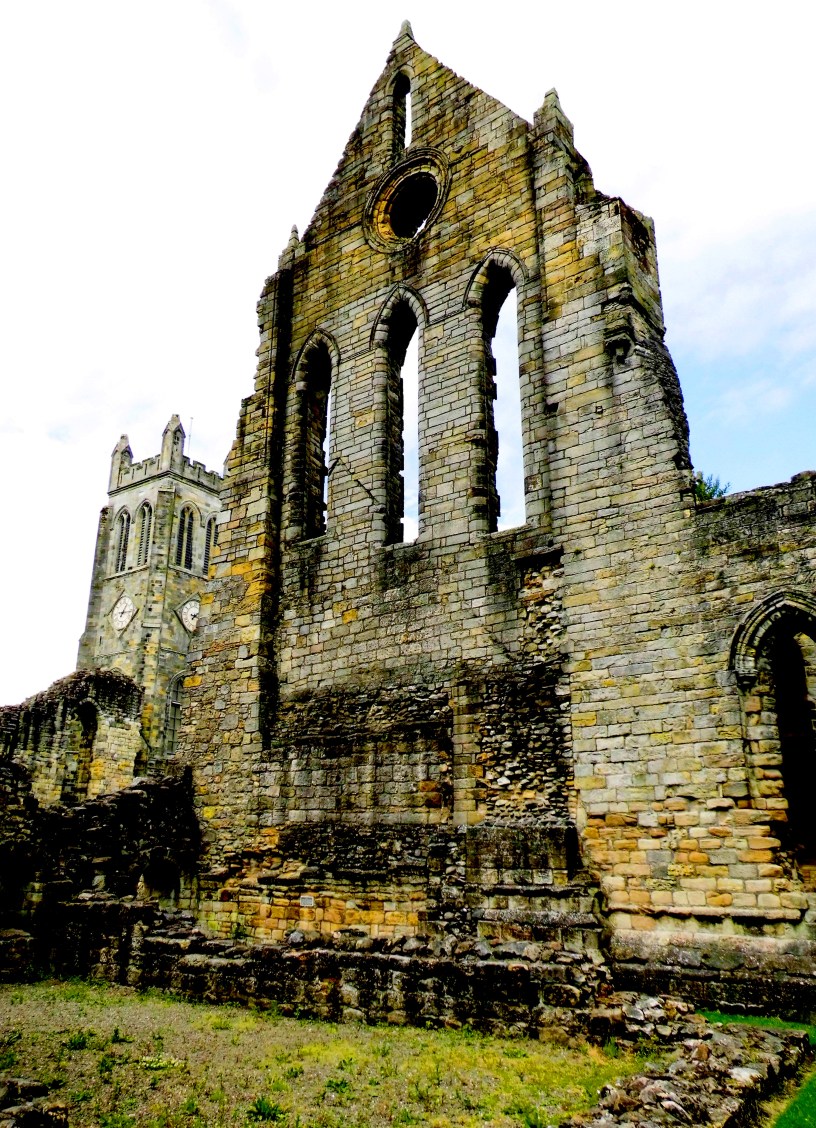
The abbey dates iteself from the latter half of the 12th Century and was founded by Tironensian monks who previously resided at Selkirk Abbey, perhaps under the patronage of the Norman lord Richard de Morville of Cunninghame, the Great Constable of Scotland under David I. Its importance is testified by the fact that in the 16th Century the Abbey received revenues from 16 other churches in the area including the chapels of St Mary and St Bridget on the Isle of Arran. At its height there were about forty monks who lived at the abbey and they would have spent their days in prayer and writing out copies of the scriptures in Latin. They also mined for coal and produced salt, perhaps at Saltcoats a very few miles away on the Ayrshire coastline.
By the time time of the Reformation in the 16th Century the number of monks had been reduced to seventeen and much of the abbey’s revenues were being siphoned off by the middle who collected the revenues. The growing dissatisfaction that people felt toward Church corruption along with the new ideology of Protestantism began to undermine the abbey’s very existence and landed gentry began to eye up church lands and wealth. And so it was that throughout that century it was plundered on a number of occasions, most notably by supporters of the radical Protestant preacher George Wishart in 1513 and by the Earl of Glencairn in 1562.
After the the Reformation there was less need for such large buildings as church power had become less centralized as individual congregations assumed greater influence over the running of their affairs. Over the next couple of centuries the abbey was slowly stripped of its stone which was taken to be used in other construction projects to the point that it eventually became the partly demolished relic that we see today.
Where to Visit
Thankfully, in this day and age, people take greater pride in their heritage and the ruins are now under the care of Historic Environment Scotland. The visitors center, located in the 1816 clock tower, is run by Kilwinning Heritage, a local history society whose volunteers would be delighted to show you around and tell you much more about the site’s remarkable history although it is best to contact them in advance to ensure guide availability.
Today the abbey may lie in ruins, but it is still a place of worship as the much smaller Kilwinning Old Parish Church is located on the site. This very handsome Presbyterian Church of Scotland was built in the earlier 19th Century and their lively congregation would warmly welcome anyone along to their Sunday services.
Please note that at the time of writing both the church and the heritage center are closed due to Covid-19.
Support Me on Patreon
For as little as $1, £1 or 1 euro you can become one of my patrons and support me in doing more livestreams, blogs and content that you want to see. Here’s the link: https://www.patreon.com/AlecMack
See you on Saturday!
Alec.
 Dark Island Guided Tours